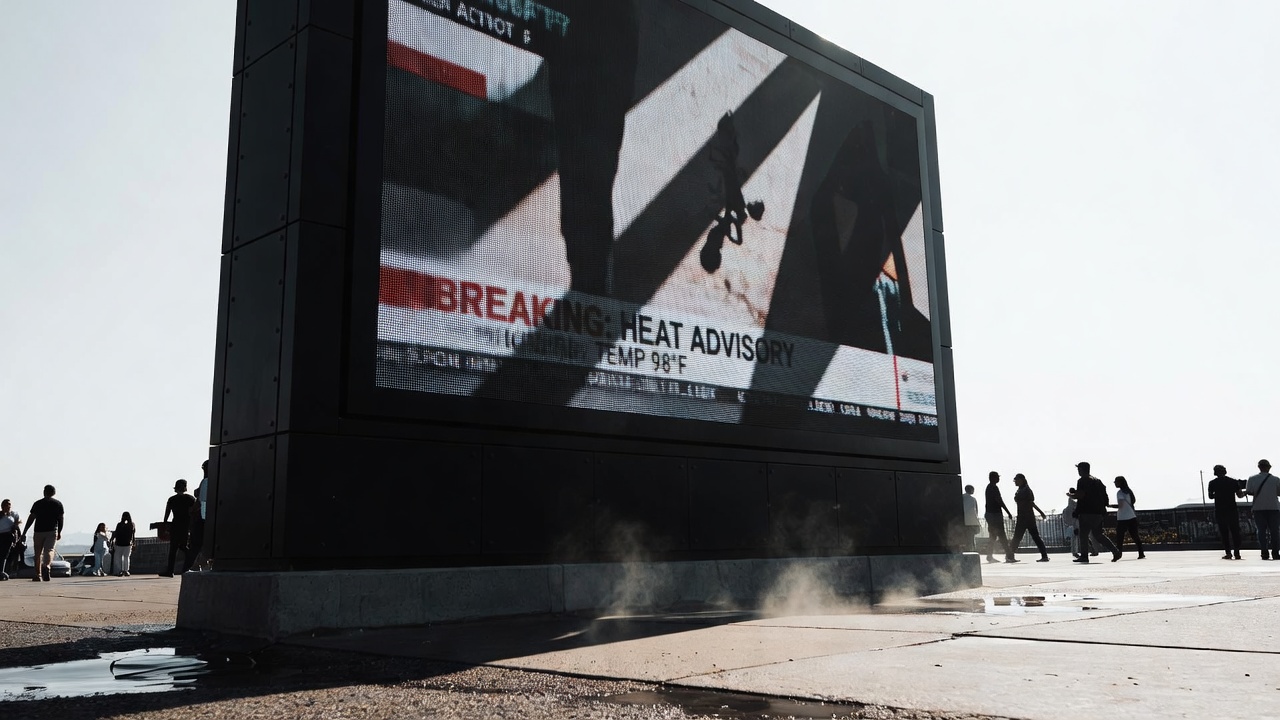
Field video: AMSCREEN
The single most common complaint about outdoor and semi-outdoor digital displays is that nobody can read them when the sun comes out. This is not a mystery. It is a physics problem, and it has known solutions — but those solutions involve tradeoffs that are worth understanding before a screen goes in the ground.
A screen competes with ambient light. Indoors, that competition is manageable — office lighting, retail overheads, and lobby fixtures are bright by human standards but modest compared to direct sunlight. Outdoors, or near large windows with southern or western exposure, the math changes dramatically. Direct sun on a screen surface is not just bright; it washes out contrast, makes dark content disappear, and can create surface reflections that obscure the image entirely regardless of what the screen is displaying.
The problem compounds when the screen surface acts as a mirror. Glossy panels, tempered glass overlays, and certain protective coatings reflect the environment back at the viewer instead of transmitting the image forward. A viewer standing in front of such a screen on a sunny day may see themselves, the street, and the sky — and almost none of the content.
Screens intended for direct sunlight exposure need output levels that consumer and most commercial indoor panels simply do not reach. The threshold where a screen starts to hold its own in direct sun is substantially higher than what most indoor commercial installations require. High-brightness panels designed for outdoor or window-facing use exist specifically to address this gap.
The key practical point: a standard commercial display moved outdoors will not perform adequately in full sun no matter how the content is adjusted. Brightness is a hardware specification. You cannot compensate for insufficient nits with content choices or software settings.
For semi-outdoor locations — covered transit platforms, open-air lobbies, parking structures with open sides — the answer depends heavily on which direction the space opens and at what hours direct light enters. A north-facing covered space behaves very differently from a south-facing one with afternoon exposure. Site surveys should document light conditions at multiple times of day, not just at the time the surveyor happened to visit.
Anti-glare surface treatments scatter reflected light rather than returning it as a coherent mirror image. The tradeoff is that they can slightly reduce perceived sharpness and, in some lighting conditions, produce a hazy appearance. Matte anti-glare finishes are generally preferable for high-ambient-light environments even at that cost. Anti-reflective coatings go further by reducing the total amount of light reflected, but they are more sensitive to scratching and harder to clean without degrading.
Circular polarizing filters are sometimes used on outdoor displays as a glare mitigation layer. They are effective in specific sun-angle conditions but can create viewing-angle issues, particularly for viewers approaching from the sides. In pedestrian-heavy environments where content needs to read from a wide arc, this is worth testing before committing to at scale.
Screen placement is the first and most durable solution to sunlight readability. A screen oriented so that its face is shaded during peak sun hours will outperform a brighter screen in direct exposure. This sounds obvious, but it is frequently overlooked when placement decisions are driven by foot traffic patterns, aesthetic considerations, or where conduit happens to run rather than by sun angle analysis.
North-facing orientation eliminates direct sun exposure in the northern hemisphere. East-facing screens get morning light and are shaded by afternoon. West-facing screens are the hardest case — they take the longest, most intense afternoon sun. South-facing screens with any tilt toward horizontal are particularly vulnerable.
Canopies, overhangs, and hoods mounted above a screen can dramatically reduce the problem without requiring a brighter or specially coated panel. These are often cheaper than a hardware upgrade and have no drawbacks beyond aesthetics and the structural requirements of attaching something to whatever the screen is mounted to. A visor that extends even a modest distance above the screen surface can eliminate direct sun contact during the worst hours while still leaving the screen fully visible from below.
Content choices cannot substitute for adequate hardware, but they can help at the margins. High-contrast content — dark text on light backgrounds, or bright elements on dark fields — reads more reliably in bright conditions than low-contrast designs. Thin fonts and fine detail disappear first when competing with ambient light; bold, high-contrast typography survives longer.
Auto-brightness scheduling, where a display management system raises output during peak sun hours and reduces it at night, extends panel life while maintaining readability. Running a screen at maximum brightness continuously shortens its useful lifespan and is unnecessary most hours of the day. A schedule tied to actual sun angle data for the installation location is more reliable than a fixed time-based schedule, which has to be updated seasonally.
The most important step before any bright-environment installation is a light audit at the actual site, at the actual times of day when the screen needs to perform. Everything else is working from assumptions.
Display brightness specs are expressed in candelas per square metre (cd/m², commonly called nits) — Wikipedia's entry explains the unit, its relationship to perceived luminance, and why the number matters differently indoors versus in direct sun.